Bradley’s escape route to Manchester
The Running ManBradley’s escape route to Manchester is a decisive act of clandestine assistance: Bradley Throckmorton uses his contacts, a false name, a vehicle, and a dangerous concealment plan to move Ben Richards out of Boston after the Games have made him a hunted fugitive. The route converts Bradley’s sympathy into material risk, while forcing Ben Richards to pass through the very systems of class policing, racial hostility, and bureaucratic visibility that define the world pursuing him.
Causes and Background
Bradley’s plan begins from the recognition that Boston is becoming a sealed trap. He explains that the highways out of Beantown are blocked and that a man wearing dark glasses would attract attention, making an ordinary journey likely to end in capture or death. His proposed answer is to obtain a car with money supplied by Ben Richards, use a name that is not yet known to the authorities, and have one of his associates drive it toward Manchester. Bradley presents Manchester as a strategic gap in the pursuit: because Ben Richards is bottled up in Boston, the authorities will be less prepared for him there.
The escape depends on informal networks rather than official infrastructure. Bradley knows a contact on Milk Street who can sell him a Wint for three hundred, and he intends to recruit one of his buddies as the driver. The arrangement is therefore both practical and precarious: the car, the false identity, and the driver are all borrowed from a world of favors and illicit transactions. Bradley’s sheltering of Ben Richards also exposes him to prosecution as an accessory, so the route is an act of personal solidarity whose consequences extend beyond the fugitive himself.
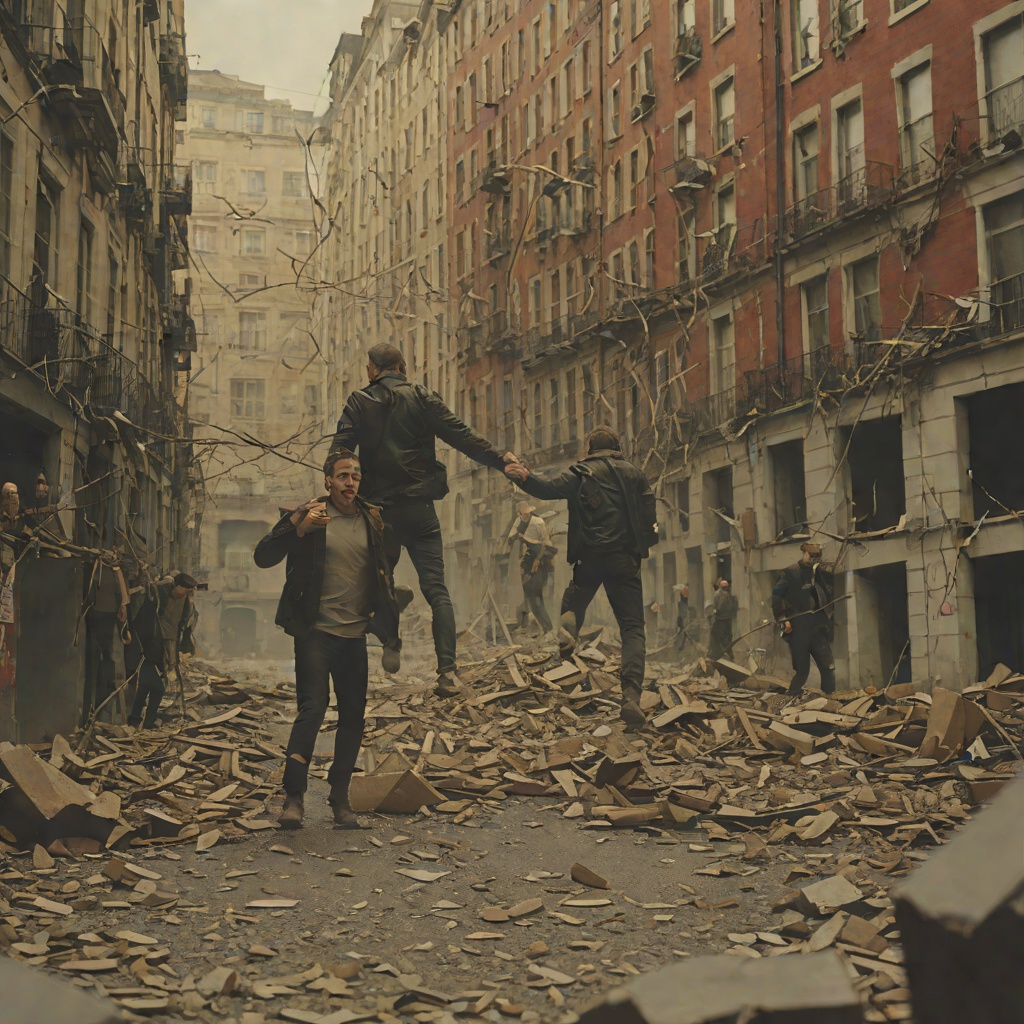
The broader city makes the journey necessary and nearly impossible. South of the Canal, Co-Op City is described as a neglected landscape of deserted shops, stripped vehicles, rats, garbage, broken sodium lights, and cycle gangs whose presence has displaced ordinary policing. The area is sharply separated from the cleaner, heavily policed districts across the Canal, where the Network Games Building rises above the city and the unemployed are funneled toward the Games. Crossing the Canal is consequently more than a change of neighborhood: it marks Ben Richards’s movement between zones with different levels of money, surveillance, and institutional control.
What Happens
Bradley conceals Ben Richards inside the trunk of the battered green Wint. Because he has not dared drill holes in the floor, Ben Richards must curl into a cramped ball with his mouth and nose turned toward the tiny light admitted by the keyhole. Bradley removes some of the trunk’s inner insulation to create a small draft, but the arrangement remains physically punishing. Before closing the lid, he gives Ben Richards a large revolver, acknowledging that discovery could require immediate violence.
Bradley describes the roadblocks through the logic of gambling. Every tenth or twelfth car receives a heavy inspection, he says, estimating the chance of avoiding a thorough search at eleven to one. The numerical language does not make the route safe; it makes the danger temporarily measurable. Ben Richards is reduced to a concealed body inside an ordinary vehicle, while survival depends on whether a routine inspection falls within or outside the calculated odds.
The car reaches an entrance ramp and begins moving through the transport system under pressure. It gains speed and height, shifts into drive, and then slows abruptly as an automated voice repeatedly orders the driver to pull over and produce a license and registration. The warning is terrifying because it seems almost inside the trunk, turning the vehicle into a moving compartment of surveillance. Ben Richards has no view of the road and cannot intervene without exposing himself; his role is reduced to remaining silent while Bradley performs normality above him.
At one checkpoint, a hand casually strikes the top of the trunk. The gesture is small, but it nearly breaks Ben Richards’s control as dust enters his nostrils and throat and an involuntary sneeze threatens to reveal him. When someone asks what is in the trunk, Bradley answers that it contains a spare cylinder that does not work properly and says that he has the key on his ring. The response is deliberately mundane, and the questioner does not demand to see inside. The escape turns on this brief success in managing suspicion: Bradley makes the hidden passenger disappear into the category of uninteresting vehicle equipment.
The route continues through a sequence of turns and controlled descents. After the car bears right, rises, pauses, turns right again, and then turns left, it settles into idle and drops with a soft bump as the engine dies. Bradley has reached the destination. He opens the trunk, and Ben Richards emerges only with difficulty, his cramped body protesting and his legs threatening to buckle. Bradley hauls him out by one arm, supports him under the armpit, and half leads and half pushes him into the driver’s seat before climbing in himself.
Consequences and Aftermath
The immediate consequence is successful passage from Boston into a new stage of flight. Bradley’s quiet declaration that they have made it there gives the journey a temporary release, but Ben Richards answers with a bitter reference to returning to the start and collecting two hundred dollars. The relief is therefore inseparable from irony: the escape has not restored freedom, only moved him to another square in a lethal pursuit.
The route’s success is also built on successive transformations of identity. Before the Boston escape, Ben Richards acquires a disguise from Molie: gray hair, spectacles, mouth wadding, plastic buck-teeth, and a slight limp. His wallet cards identify him as John Griffen Springer, a forty-three-year-old widower and text-tape salesman from Harding. The disguise is not merely cosmetic. It attempts to alter how strangers classify him, replacing the visible fugitive with a socially legible, older, less threatening traveler. Yet the need for such elaborate management shows how completely the Network’s system turns appearance, documents, speech, and behavior into instruments of detection.
The escape route also follows earlier scenes of institutional and social labeling. At the Games facility, a bulletproof Judas hole and a policeman chanting for people to step to the rear reduce applicants to controlled bodies moving through a secured building. At the Boston Y.M.C.A., the clerk’s open racial hostility reveals another form of exclusion, one that treats a black child as presumptively dishonest and imagines cages as a proper response. These encounters make Bradley’s route more than a vehicle journey: it is a passage through a society in which race, poverty, employment status, and suspected criminality determine who may move without explanation.
Bradley’s operation stands against the Network’s larger machinery of pursuit. The Network has calculated around people like Ben Richards as though they were particles within a predictable social order, while Evan McCone embodies the coercive force behind that order as Chief Hunter. Against this impersonal system, Bradley deploys local knowledge, an old car, a driver, a false identity, and the willingness to improvise under pressure. The route does not defeat the system; it exposes the narrow, human intervals through which the system can still be evaded.
Narrative Significance
As an event, Bradley’s escape route is structured as an escape plot under conditions of extreme social visibility. Its central value shift is from apparent entrapment in Boston to temporary mobility, but the change remains unstable because mobility requires concealment rather than recognized freedom. The trunk makes that contradiction literal: Ben Richards is transported because he cannot safely appear as himself.
The event also gives Bradley’s relationship with Ben Richards its clearest practical form. Bradley does not merely express opposition to the Network; he places his vehicle, contacts, household, and legal safety at the fugitive’s disposal. His plan is careful enough to include inspection odds and a draft through the insulation, yet desperate enough to depend on a revolver and a false explanation about the trunk. The escape route therefore reveals solidarity as a craft of detail, performed through logistics in a world where one careless question, gesture, or breath can end a life.
The journey’s imagery reinforces the book’s geography of inequality. It begins amid the blighted streets of Co-Op City, passes the Canal that divides the unemployed from the guarded prosperity uptown, and uses modern transport infrastructure as both escape corridor and surveillance channel. The abandoned or unfinished spaces elsewhere in the flight, including the Super Pine Tree Mall’s maze of half-built stores, foundation holes, rusted steel, and overgrown roads, continue the same pattern: spaces designed for circulation and consumption have become hiding places. Bradley’s Manchester route thus links personal flight to the physical production of a divided society, where neglected zones create the only room left for resistance.